
明天我依然爱你
How a Chinese game scholar connects ancient texts with modern play_我的网站

一 |
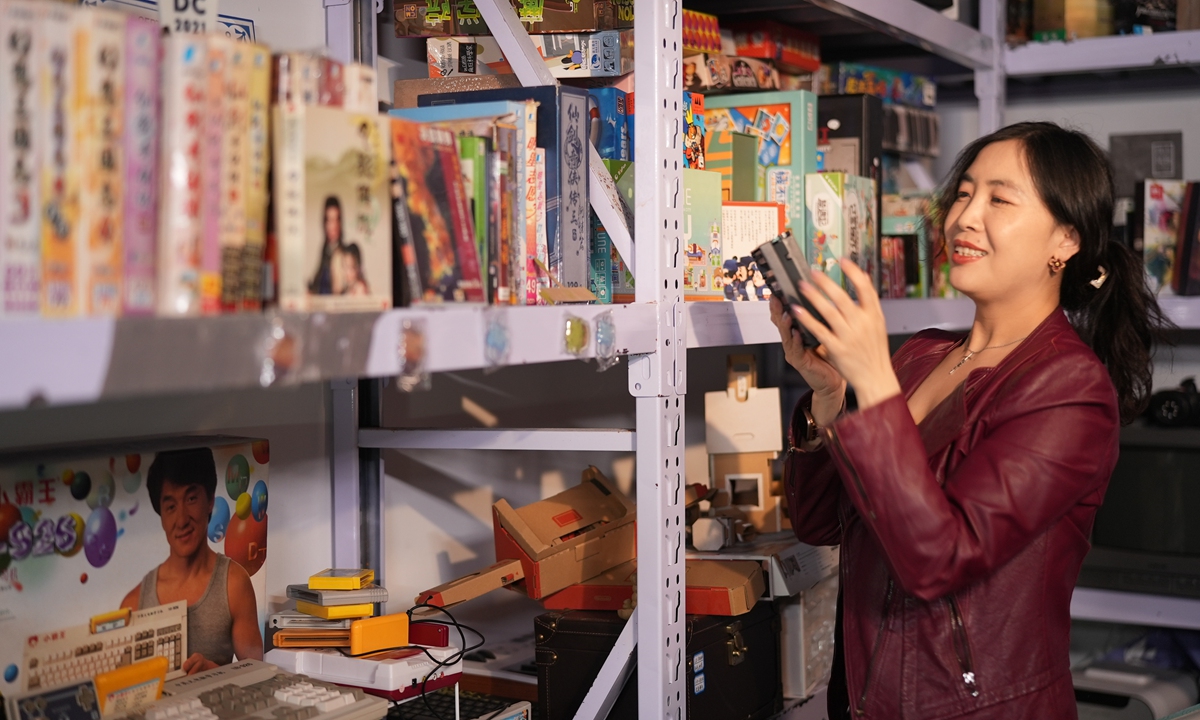
Inside Beijing's Homoludens Archive, shelves are filled with books, game consoles, game cartridges and other materials tracing the history of video games. For Liu Mengfei, the archive's director and chair of the academic committee of the Gamification Professional Committee, these collections preserve more than the evolution of games, they also capture the cultural memories of a generation.
A PhD in history from Tsinghua University, Liu has spent more than a decade studying the social impact of games, the role of games in history and digital humanities. Throughout her career, she has continued to explore the relationship between games and people: Why do humans create games? And how do games shape culture and society?
Books, meanwhile, have been an important gateway through which Liu has come to understand the world of games.
"The real value of a book lies not simply in what it tells you, but in whether it can change the way you understand the world and people," Liu told the Global Times.
Books meet games
In 2007, being an undergraduate history student, Liu wrote her thesis on the links between ancient Celtic religion and modern digital games.
To study original sources such as The Gallic War by Roman author Julius Caesar, she taught herself Latin. As her research extended into modern games, she also began reading the rulebooks of Dungeons & Dragons, a tabletop role-playing game.
"From historical texts to game rulebooks, these reading experiences seemed to belong to completely different worlds, but they gradually led me to realize that games are not simply entertainment products. They also contain history, culture and the relationships between people and society," she said.
Later, Homo Ludens, by Dutch historian Johan Huizinga, further transformed the way she understood games. The book gives a theory that humans are not only Homo sapiens, or "rational beings," but also Homo ludens, or "playing beings," and that games are deeply intertwined with human culture, from language and art to religious rituals and sports.
The book had a profound influence on her. It points out that the foundations of human society — language, civilization, religious rituals, sports and art, are all connected to play and games, because we are Homo ludens, "the playing human."
"The idea prompted me to view games from a broader perspective," Liu said. "Games are not an appendage outside human civilization, but are deeply connected to cultural creation and social life."
"It also showed me that games and game-based thinking could extend into broader fields, including education and technology," she added.
She later read other works on game studies, including Play Between Worlds: Exploring Online Game Culture, Half-Real and Rules of Play Game Design Fundamentals. Play Between Worlds, in particular, opened up another possibility for game studies at a time when discussions about "internet addiction" were prevalent in China.
"Games are not simply a form of entertainment that needs to be restricted or criticize;. they can also serve as important media for storytelling, cultural expression and exploring relationships," she said.
These reading experiences gradually shifted Liu's focus from simply asking "What are games?" to a deeper question: What can games bring to people?
Beyond time and technology
Periodically, Liu still returns to Homo Ludens in her free time, finding new insights from the book as society changes. In the age of artificial intelligence, she has revisited one of its fundamental questions: As AI becomes increasingly capable of handling repetitive tasks and surpasses humans in efficiency, what does it mean to be human?
"As AI takes over more monotonous and repetitive work, the time freed up should be devoted to creativity, experience and human relationships," she said. "The time we gain should actually be used to become better at 'playing humans.'"
For Liu, this also requires people to maintain their ability to think, imagine and reflect -- abilities that cannot be gained through simply receiving information. This has also prompted her to reconsider the meaning of reading.
In an era when AI can quickly summarize an entire book, Liu believes people still need to read the original works in full, because the value of reading lies in more than simply acquiring knowledge and conclusions.
"Reading a book is like a form of cultivation. You have to immerse yourself in it, patiently allow the author to take you on a journey, and find your own island along the way," she said.
For Liu, the value of reading is not limited to books on paper. As media evolve, so do the ways people encounter stories and understand culture. Some digital works are now becoming new vehicles for reading.
Chinese-developed games such as Genshin Impact contain hundreds of thousands, and even more than a million Chinese characters of text, while Black Myth: Wukong uses its "Journal" system to tell the stories of individual monsters through written entries.
"Digital games are carrying forward traditions inherited from literature and film, becoming new gateways, through which young people can enter the worlds of literature, history and traditional culture," she said.
"An important reason why Black Myth: Wukong has succeeded in communicating Chinese culture is that it does not simply insert traditional cultural symbols into a game. Instead, it draws on the original Journey to the West, contemporary works inspired by the classic, as well as the game's own rules and interactions, allowing players to develop a new understanding of traditional culture through their actions," she noted.
For Liu, the forms of reading may change, but the desire to understand the world and discover oneself will not. From books to digital worlds, what matters is not only what people read or play, but how they think, create and find meaning through these experiences.
。
[ 资讯] 日前,广汽本田汽车有限公司、东风本田汽车有限公司根据《缺陷汽车产品召回管理条例》、《缺陷汽车产品召回管理条例实施办法》和《机动车排放召回管理规定》的要求,向国家市场监督管理总局备案了召回计划。决定召回以下车辆:召回批次:
。Current article:http://h7m6krh.shuicengchongmingnouhuawang.bond/fl0/sqt.html
Published on:03:36:23
天眼查_Random reading
- 08-21Rajinikanth Receives Lifetime Honour At IFFI
- 08-241400多家宠物医院创始人“出走”背后
- 08-23最新民调:总理的支持率暴跌,民众对政府不满意
- 08-21这家信托7名负责人被警告或禁业;因股权3次流拍,信保基金接盘安信信托;多家信托推进增资… | 周报_对公司_吉林信托
- 08-26深入禁区清除感染!《轮回保险公司 R.I.P》1.0版定档9月16日
- 08-26天猫客服私自篡改售后诉求,售后推诿扯皮
- 08-25Exclusive: ‘Shaomai cartoon’ satirizes US’ abuse of concept of national security targeting Chinese tech firms, ambassador tells GT
- 08-25贝泰妮:2026H1扣非劲增35%,多品牌矩阵兑现提速
- 08-26Unity 7预计2027年Q1推出 基于Unity 6延展功能
- 08-22vivo X500 Pro Max首发蓝图光御900:支持CIPA 7.0专业级防抖 彻底根治糊片问题

柳叶刀_Active users
- Musk denies speaking to Putin about Ukraine war
- 重磅!巴萨签下30岁金球先生 年薪1500万 曼城已接受7650万欧报价
- 商品期货早盘多数下跌,沪锡跌近5%,PVC、沥青跌超3%_涨超_燃料油
- 深圳华智融科技股份有限公司深圳市商雅达科技有限公司
- 监管重拳!A股公司实控人收3560万天价罚单,创年内新高
- 拥军模范高英:从青丝到白发,四十二载丹心暖军营
- 阿里明确电商战略重心,三大举措服务实体经济,阿里明确电商战略重心,三大举措服务实体经济
- 恒生活借款58好借的担保费超标,我要退多收的钱
- 纽约铜价再创历史新高 美国市场持续虹吸全球库存
- China's commercial freight volume hits 4.9 billion metric tons in July
- 一觉醒来,加拿大政府垮了
- 法甲:姆巴佩回归 “大巴黎”主场大胜
- India saved Sri Lanka: JVP
- 和邦生物:董事贺正刚拟减持不超4182.4万股公司股份
- 苹果据悉将推出两年来首款新Mac mini
- China activates Level IV emergency response for typhoon, heavy rain as three typhoons simultaneously present at sea near China’s coastal areas
- EU slams sanctions on Iran's morality police, minister
- Chief Justice Lalit recommends Justice DY Chandrachud as his successor and as 50th CJI
七十二家房客_Hottest this week
- 08-25什么!因凡蒂诺要把世界杯“卖”了?
- 08-20PM releases 12th instalment of Rs 16K cr under PM-KISAN through Direct Benefit Transfer
- 08-24双色球2026080期开机号分析(附历史)
- 08-20国旗下的故事 | 预防诺如病毒 呵护健康成长
- 08-20ट्रंप हमें पसंद नहीं... अमेरिका छोड़ दुबई, सिंगापुर, स्विट्जरलैंड, पुर्तगाल का रूख कर रहे अरबपति
- 08-26争取“十五五”期间新建3个国字号产业基地
- 08-24全新大型SUV 与腾势N9组成双子星 腾势N8L内饰首次曝光
- 08-23联讯仪器:上半年归母净利润5.67亿元,同比增长903%
- 明天我依然爱你 copyright
- Some of the content comes from the Internet. If you have any offence, please raise it.